

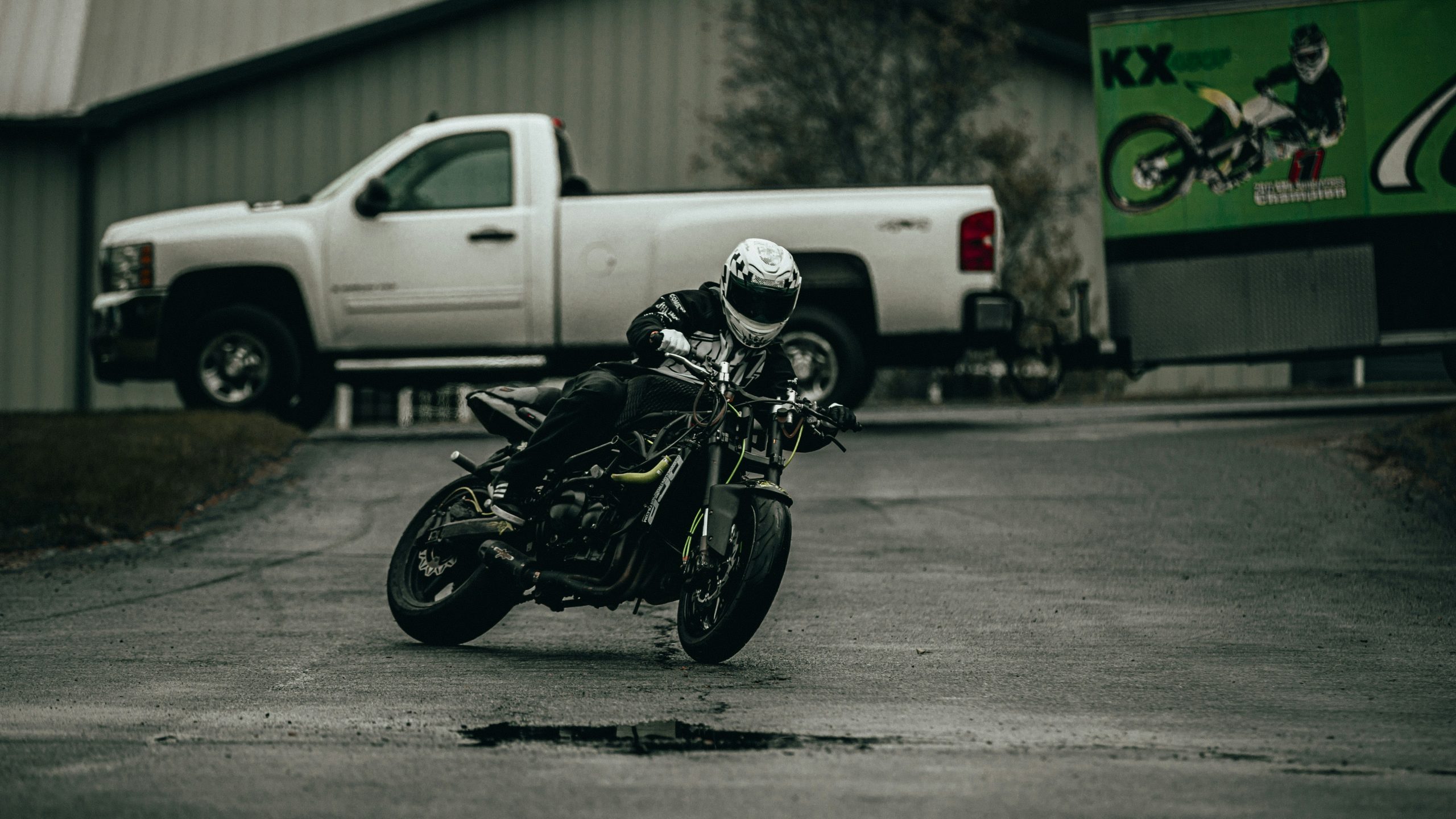
Every motorcycle comes with two brakes: Front and rear. They’re both important, but they don’t do the same thing! Let’s understand motorcycle braking first: What Do Front and Rear Brakes Actually Do?
Front Brake is Your Main Stopper
- Think of the front brake as the powerful one.
- When you pull the front brake, most of the braking force goes to the front wheel.
- Why? Because of physics — when you slow down, the bike’s weight shifts forward, putting more pressure on the front tire. That means it can grip the road better and stop you faster.
Rough estimate:
➡️ The front brake handles 70% to 80% of the stopping power.
Rear Brake is the Support System
- The rear brake is more of a stabilizer.
- It helps keep the bike balanced and straight.
- It doesn’t stop you as fast as the front brake, but it adds control, especially at lower speeds or in tricky situations.
Rough estimate:
➡️ The rear brake handles 20% to 30% of the stopping force.
How Braking Works on a Motorcycle (The Physics in Simple Words)

When you brake on a motorcycle, here’s what happens:
- Weight shifts forward.
- The front suspension compresses.
- The front tire gets more grip.
- The rear tire becomes lighter (and can even lift slightly during hard braking).
This is why:
- The front brake is more effective.
- But also more dangerous if not used correctly.
When to Use Front, Rear, or Both Brakes?

Let’s break it down by situations:
A. Everyday Riding (Smooth Roads, Normal Traffic)
Best Practice: Use both brakes together.
- Gently squeeze the front brake (not grab).
- Apply smooth pressure to the rear brake (not stomp).
- This gives the best stopping power and stability.
Why both?
- The front does most of the work.
- The rear adds balance, especially at slower speeds.
B. Slow Speeds (Parking lots, traffic jams, U-turns)
Best Practice: Use mostly rear brake.
At slow speeds:
- The bike is more wobbly.
- The front brake is too strong and can cause jerky stops or even a tip-over.
Use the rear brake to stay stable while keeping the handlebars relaxed.
Example:
You’re doing a U-turn in a narrow alley. You want the bike to stay stable and smooth. Lightly dragging the rear brakehelps control speed without upsetting balance.
C. Emergency Braking (Sudden Stop)
Best Practice: Use both brakes firmly and progressively.
This is where technique matters:
- Don’t panic.
- Roll off the throttle.
- Apply both brakes at the same time — firmly but smoothly.
- As weight shifts forward, you can increase pressure on the front brake.
If your bike has ABS (Anti-lock Braking System), it helps prevent the wheels from locking. If not, you have to modulate manually (more on this later).
What happens if you grab only the front brake?
- The front wheel could lock.
- You might crash or flip over.
What if you use only the rear brake?
- You won’t stop in time.
- The rear tire may skid and lose control.
Pro Tip:
Always practice emergency stops in a safe area like a parking lot.
D. Wet Roads, Sand, Gravel
Best Practice: Be extra gentle – use more rear brake.
On loose or slippery surfaces:
- The front tire can slide easily if you brake hard.
- The rear brake gives more stability.
Use mostly rear brake + gentle front brake.
Keep these in mind:
- Brake early.
- Brake gently.
- Ride slower overall.
Example:
You’re riding in light rain, and there’s gravel near a construction zone. If you panic-brake with the front, the front tire might wash out and cause a crash. Use more rear, less front, and do everything smoothly.
E. Braking in a Curve or Turn
This one’s tricky.
Best Practice: Brake before the turn, not during.
- Slow down using both brakes before entering the curve.
- While leaning, avoid braking — especially the front.
- If you must brake mid-turn, use a little rear brake only, very gently.
Why?
- Braking in a lean can upset the balance and cause a slide.
Real-life example:
You’re taking a left-hand curve and suddenly spot sand. If you squeeze the front brake in a lean, the front tire may slide. Instead, ease off the throttle, straighten up a little if possible, and use gentle rear brake.
4. What Not to Do (Common Mistakes That Cause Crashes)

Here’s what you should absolutely avoid:
Grabbing the Front Brake Suddenly
- This causes the front tire to lock.
- The bike can skid or flip.
- Instead: Always squeeze the front brake gradually.
Using Only the Rear Brake All the Time
- The stopping distance becomes longer.
- The rear tire might skid, especially under heavy braking.
- You lose valuable braking power.
Braking Hard in a Turn
- The bike is already leaned over.
- Braking adds instability.
- It’s one of the most common causes of low-side crashes.
⚙️ 5. How to Practice Proper Braking

Here’s how to build your skills:
🔄 Practice Routine:
- Find a safe, open area (like an empty parking lot).
- Practice stopping from 20–30 km/h using both brakes.
- Focus on smooth pressure, no jerky movements.
- Try braking on straight lines and slight curves (cautiously).
- Practice emergency stops — simulate a sudden stop and brake firmly without skidding.
Adjusting Braking for Conditions
☀️ Dry Road
- Use both brakes with confidence.
- More pressure on front.
🌧️ Wet Road
- Use more rear brake.
- Be smoother with the front.
🪨 Gravel/Dirt
- Use mostly rear.
- Stay light on the front brake.
🏙️ Traffic
- Rear brake helps with low-speed control and smoother stopping.
- Use front only when needed.
💡 7. What About ABS?

ABS (Anti-lock Braking System) helps prevent wheel lock-up during hard braking. If your bike has it:
- You can brake harder without fear of skidding.
- Still, develop good habits — ABS is a backup, not a substitute for skill.
✅ Summary – What You Should Remember
| Situation | Use Front Brake | Use Rear Brake | Notes |
|---|---|---|---|
| Normal riding | ✅ Yes | ✅ Yes | Use both smoothly |
| Slow speed | ⚠️ Lightly | ✅ Mostly | Rear gives balance |
| Emergency stop | ✅ Firmly | ✅ Firmly | Don’t panic – be smooth |
| In a turn | ⚠️ Avoid | ⚠️ Very light | Brake before the curve |
| Wet/gravel | ⚠️ Lightly | ✅ More | Be extra gentle |
Now that you have all the information you needed, we hope you ride safely! Have a great ride!


Leave a Reply
You must be logged in to post a comment.